If your team only tracks classic blue-link rankings, you are flying half-blind. Buyers now ask ChatGPT, Perplexity, Google AI Overviews, and Gemini for shortlists and explanations. Those answers may name your brand, link your domain, or skip you entirely, and none of that shows up as a tidy position-three row in a rank tracker.
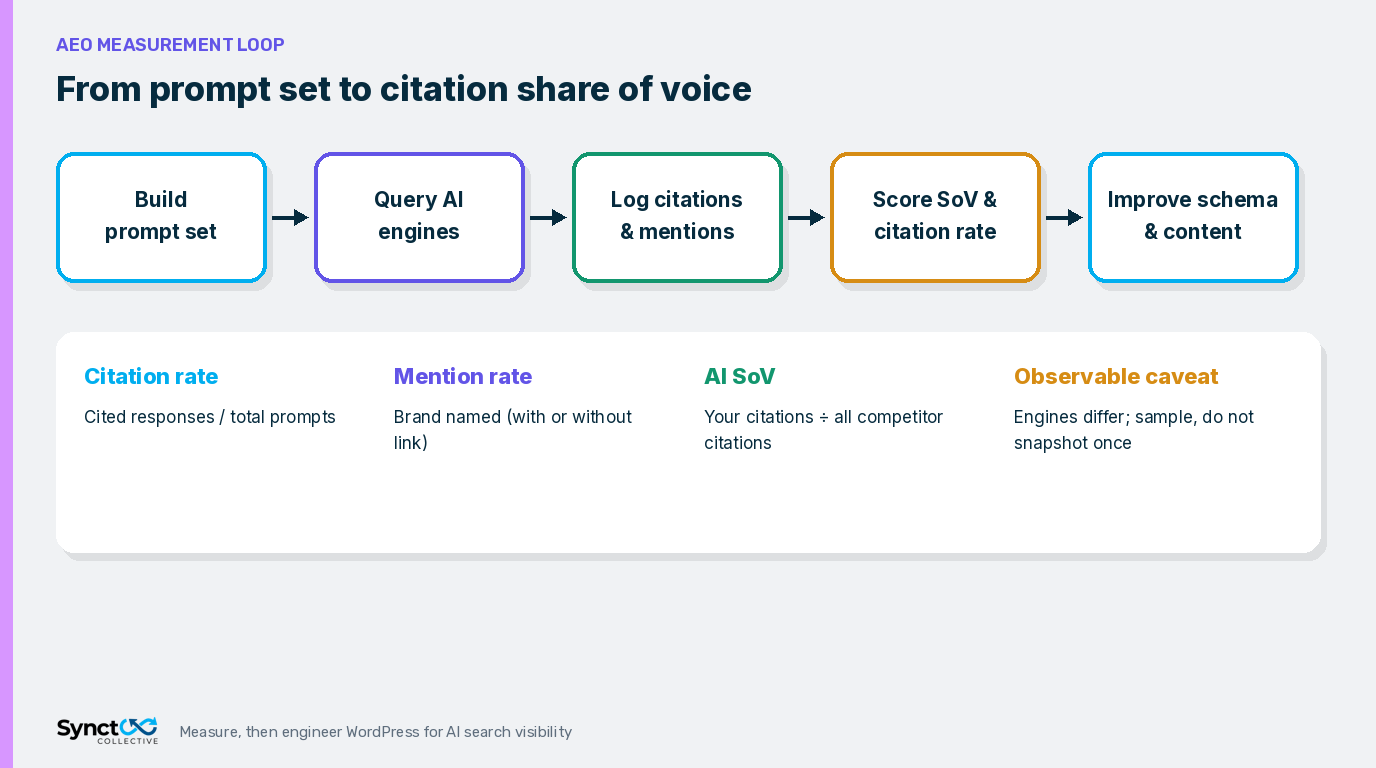
This playbook shows how Synct Collective helps B2B teams measure AI search citations on WordPress estates: fix a prompt set, log what is actually observable, score citation rate and share of voice over time, then improve the entity, schema, and answer-shaped content that generative engines can trust. It sits alongside our notes on AEO domains and AI search engine trust, client portals with RBAC and GEO schema, and native Gutenberg vs headless for Core Web Vitals and AEO.
Why classic rank tracking is not enough for AEO measurement
Rank trackers answer a useful question: where do we sit for a keyword in organic results. Generative answers ask a different one: when a model synthesizes a response, does it cite or mention us?
If you are an Isle of Man business, we run the same prompt panel against local questions such as "best WordPress SEO in Douglas", as part of our AI search work for Manx businesses.
Those systems are probabilistic. The same prompt can return different sources on different days. Some surfaces show clear outbound links; others paraphrase without a clickable citation. Google's own guidance on AI features and your website is clear that AI Overviews and AI Mode still reward foundational SEO (crawlable, people-first content) and that performance for those features rolls into Search Console's overall Web performance data rather than a separate "citation rank."
So generative engine optimization tracking is closer to brand-media measurement than to classic SERP position: define a panel, sample repeatedly, and report rates, not a single screenshot.
Practical rule: if leadership asks "are we winning in AI search?" and the only artifact is one ChatGPT chat from last Tuesday, you do not yet measure AI search citations. You have an anecdote.
What counts as a citation (be honest about observability)
Before you build dashboards, agree definitions. Synct Collective uses four labels in every log row:
- Linked citation: the answer includes a URL or clear source card pointing at your owned domain (or a page you control).
- Unlinked mention: the brand or product name appears in the answer text without a link.
- Competitor cite: a named competitor receives a linked citation or recommendation slot.
- Absent: neither you nor a tracked competitor appears for that prompt/engine run.
Observability differs by surface:
- Perplexity and similar citation-forward tools often expose sources you can log consistently.
- ChatGPT citations for brand research vary by mode, browsing state, and product UI, so treat linked sources and plain-text mentions as separate columns.
- Google AI Overviews / AI Mode may show supporting links; Google documents that eligibility follows normal Search indexing and snippet rules, not a special AI-only schema file.
- Gemini and other assistants: log what the UI actually shows that week; do not invent a citation that was only implied.
Honesty beats vanity. ChatGPT citations brand work is valuable when the spreadsheet distinguishes "named in prose" from "linked as a source."
Step 1: Build a fixed prompt set
AEO measurement starts with a governed prompt panel, usually 25 to 50 prompts for a focused B2B category, more if you run multiple products or regions. Split the set into three buckets:
- Branded: "What does [Brand] do?", "Is [Brand] good for [use case]?", " [Brand] vs [Competitor] for [job]."
- Category / problem: buyer questions without your name: the prompts that decide whether you enter the consideration set.
- Competitor comparison: head-to-head and "best tools for X" prompts where recommendation order matters.
Version the panel. Freeze wording for a measurement window (for example four weeks), then revise deliberately when products or markets change. If the prompt text drifts every week, your citation rate chart is noise.
Map each prompt to an owner page on WordPress: the URL that should earn the citation if content and entity clarity are working. That mapping is how measurement feeds engineering backlog instead of becoming a vanity report.
Step 2: Log citations across engines on a cadence
Run the same panel on a schedule (weekly for active programs, biweekly for smaller teams). For each prompt × engine × date, record:
- Engine and product mode (for example ChatGPT with or without browsing, AI Overview present or not).
- Outcome label (linked citation / unlinked mention / competitor / absent).
- Cited URL if any, and whether it is owned, earned media, or a directory.
- Position cues when visible (first recommendation, buried in a list, footnote-only).
- Notes for hallucinations or outdated product claims; those are content bugs, not just SEO tickets.
Prefer a shared sheet or warehouse table over private browser history. Sample size matters: one run is a draw from a stochastic system; a month of repeats is a trend. When you automate later, keep the human-readable log schema so engineers and marketers still speak the same language.
Step 3: Score citation rate and AI share of voice
Turn the log into two primary rates for generative engine optimization tracking:
- Citation rate (owned): linked citations to your domains ÷ total prompt runs in the window (optionally split by engine).
- Mention rate: linked citations + unlinked mentions ÷ total runs, useful for brand inclusion, weaker as an authority signal.
- AI share of voice: your linked citations (or mentions, if you define it that way) ÷ all linked citations (or mentions) across your tracked competitor set for the same prompt panel.
Report engines separately before you blend them. An average that hides "strong on Perplexity, invisible in AI Overviews" is not actionable. Weight engines only when you have evidence of buyer usage in your segment, and write the weighting rule down.
Pair AI rates with first-party proxies you already trust: branded query trends in Search Console, referral sessions from known AI hosts when they appear in analytics, and sales notes that mention "found you via ChatGPT." Those proxies do not replace citation logs; they triangulate them.
Step 4: Iterate what models can trust: entity, schema, domain, answers
Measurement without a change loop is theater. When citation rate stalls, Synct Collective looks at WordPress-side levers that improve machine-readable clarity without spamming schema:
- Entity clarity: consistent Organization name, legal identity, and sameAs-style corroboration so models can resolve "who you are." See schema.org Organization for the vocabulary surface area; use only properties that match visible facts.
- Structured data that matches the page: Google's introduction to structured data stresses that markup should describe on-page content, prefer maintainable JSON-LD, and avoid empty or invisible claims. For B2B WordPress, Organization, Service, and carefully scoped FAQ markup help Search understand pages; they are not a secret AI-citation cheat code. Google also notes there is no special schema required solely to appear in AI Overviews.
- Owned domain trust: clean hosting identity, coherent brand domain strategy, and authoritative .com presence still matter when engines choose sources, themes we cover in AEO and domain trust and why your domain name defines brand authority.
- Answer-shaped content on Gutenberg WordPress: clear H2 questions, concise definition blocks, comparison tables, and FAQ sections that humans actually read. Native block content keeps text extractable and fast; pair that with the performance mindset in our headless vs native Gutenberg guide. For portal and product entities, align public schema with the patterns in RBAC schema and GEO for client portals.
After each content or schema release, keep measuring for several cycles before you declare victory. AI answers lag crawl and training or retrieval freshness; weekly panic edits produce more variance than learning.
A lightweight operating cadence
- Weekly: run the prompt panel on priority engines; update the log; flag hallucinations.
- Monthly: publish citation rate and AI SoV by engine; pick the top five prompt gaps for content/schema work.
- Quarterly: refresh competitor set and prompt panel; review branded Search Console trends; retire prompts that no longer map to revenue conversations.
Keep the artifact boring and durable. Fancy AI-visibility SaaS can sit on top later; the contract with leadership is still "here is the panel, here is the rate, here is what we changed on WordPress."
Frequently Asked Questions (FAQs)
Q: What does it mean to measure AI search citations?
A: It means sampling a fixed set of buyer and brand prompts across AI answer surfaces, logging whether your owned URLs (or brand name) appear, and tracking citation rate and share of voice over time, not relying on a single chat screenshot or classic keyword rank alone.
Q: How is AEO measurement different from SEO rank tracking?
A: Rank tracking scores positions in organic result lists. AEO measurement scores inclusion and sourcing inside generated answers, which are probabilistic and often lack a stable "position." You need repeated samples and rate metrics, plus honesty about what each engine exposes.
Q: Can we track ChatGPT citations for our brand without a vendor tool?
A: Yes. Start with a spreadsheet: prompt, date, mode, linked citation vs unlinked mention, cited URL, competitors present, and notes. Vendor tools help at scale; they do not replace clear definitions and a frozen prompt panel.
Q: Does FAQ or Organization schema guarantee generative engine citations?
A: No. Schema helps search systems understand entities and page meaning when it matches visible content, as Google describes in its structured data introduction. Google also states there is no special AI-only markup required for AI Overviews. Treat schema as clarity infrastructure, then keep measuring citation rates.
Q: Where should generative engine optimization tracking live for a WordPress team?
A: Own the prompt panel and log in a shared workspace, map each prompt to a WordPress URL, and route gaps into editorial and engineering backlog (entity pages, Services, FAQs, performance). Synct Collective's enterprise WordPress practice treats measurement and implementation as one loop.
Need AI citation measurement wired to WordPress engineering?
If your organization needs a governed prompt panel, citation log, and a WordPress backlog that improves entity clarity, schema, and answer-shaped content. Synct Collective helps teams measure and engineer for AI search visibility without chasing unverifiable shortcuts.
Contact the team at Synct Collective to scope AEO measurement and the WordPress changes that move citation rate and share of voice.


