
More people now ask Google or ChatGPT a question and read the answer before they click anything. "Who builds WordPress sites in Douglas?" "Is there an accountant in Ramsey who works with startups?" If your business is not part of those answers, you can lose the enquiry without ever seeing it in your analytics.
This guide explains, in plain English, how Google AI Overviews and ChatGPT decide which businesses to mention, and the practical steps our team uses to give a business the best chance of being found and described correctly. We use the Isle of Man as the worked example because it is where we are based, but the same approach applies to any local business.
The short answer
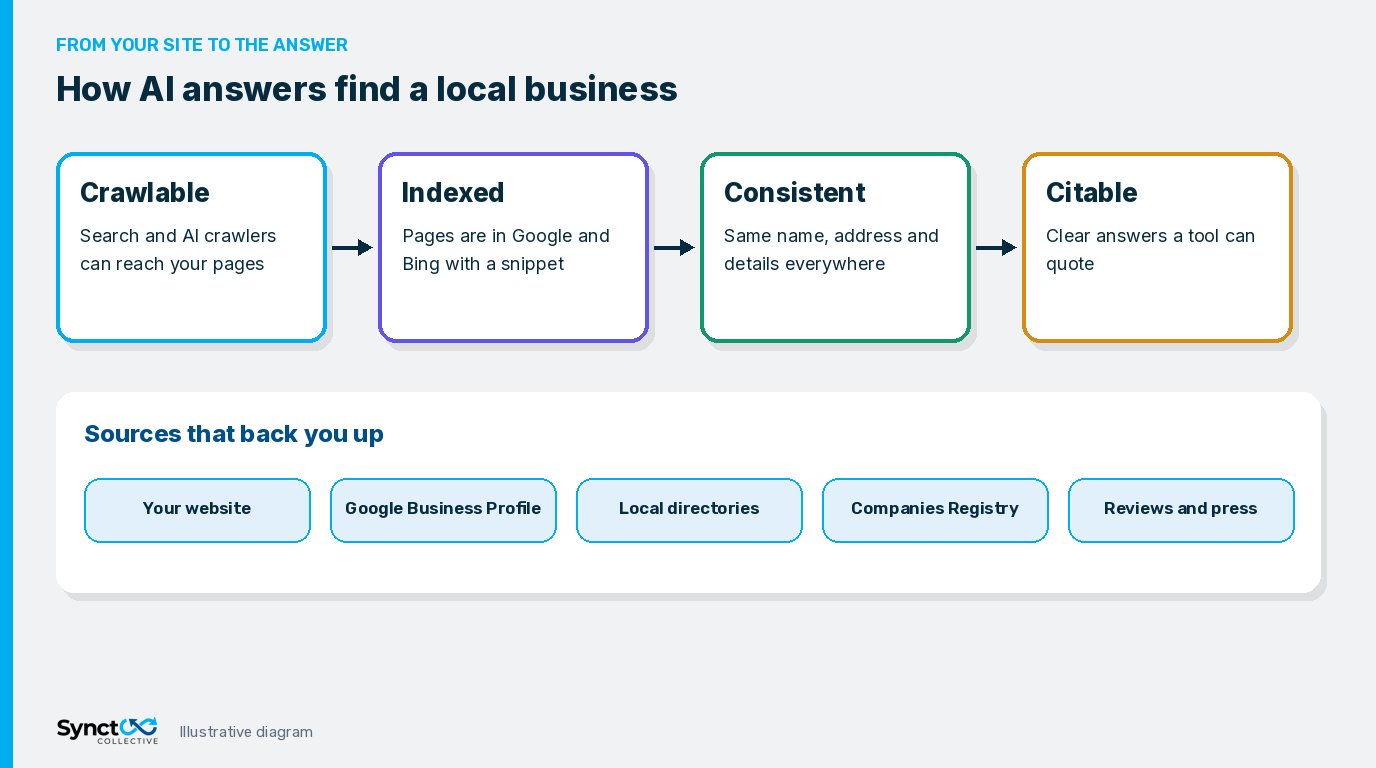
You cannot buy a place in an AI answer, and nobody can promise one. What you can do is make your business easy for these tools to find, understand and trust:
- Be crawlable and indexed. Google and the search systems behind ChatGPT have to be able to reach and store your pages.
- Answer real questions clearly. Put direct answers near the top of your key pages.
- Keep your details consistent everywhere. Same business name, address, email and description on your site, your Google Business Profile and local directories.
- Back it up with structured data and outside sources. Accurate schema on your site, plus mentions on trusted local sites.
How Google AI Overviews choose sources
Google's own guidance on AI features and your website is refreshingly direct. There are no special technical requirements or extra markup for AI Overviews. To be shown as a supporting link, a page must be indexed and eligible to appear in Google Search with a snippet. The same SEO basics that help a page appear in normal results are what make it eligible here.
That means the first job is not "AI optimization" at all. It is checking that your important pages are actually indexed. If Search Console shows them as "Crawled, currently not indexed", start with our guide to fixing pages Google crawls but does not index.
How ChatGPT finds businesses
ChatGPT can answer from what it learned in training, and it can also search the web for current information and show the sources it used. OpenAI publishes details of its crawlers, including OAI-SearchBot, which is used to surface websites in ChatGPT search results. If your robots.txt or firewall blocks that crawler, your pages are less likely to appear as a linked source.
Because ChatGPT and similar tools build their answers from many sources, what other websites say about you matters as much as what your own site says. If your address, services or even your business name differ between sites, a tool has to guess which version is right, and it may simply leave you out.
Why this matters more for Isle of Man businesses
A small market works in your favor and against you at the same time. There are fewer local sources for AI tools to draw on, so each one carries more weight. A single out-of-date directory listing can be the main thing a tool "knows" about you.
For Manx businesses, the sources worth getting right usually include:
- Your own website, especially your About, Contact and service pages.
- Your Google Business Profile.
- Local directories such as Manx Directory, LocalIOM and ShopIOM.
- Your entry on the Isle of Man Companies Registry, with the same legal name and company number your site shows.
- Local press, chamber or association listings, and genuine customer reviews.
We walk through how we handle this for local clients on our AI search optimisation page for Isle of Man businesses.
Step by step: what we do first
1. Check crawler access
We review robots.txt, firewall and bot protection rules to confirm Googlebot, Bingbot and the main AI search crawlers can reach your public pages. Overly strict bot blocking is one of the most common reasons a site is invisible to AI tools.
2. Confirm indexing in Google and Bing
We use Search Console and Bing Webmaster Tools to check that key pages are indexed, then fix canonicals, thin archives and weak internal links that hold them back. Submitting changed pages through IndexNow helps Bing and other participating engines pick up changes quickly.
3. Rewrite key pages so the answer comes first
AI tools quote passages that answer a question directly. We make sure each service page says clearly what you do, who it is for, where you work and what it costs, in the first few lines, then add a short FAQ with the questions customers really ask.
4. Add accurate structured data
We add Organization or LocalBusiness, Service and FAQ schema that matches what the page visibly says. Schema does not force a mention, but it removes ambiguity about who you are. Our post on nested JSON-LD for WordPress shows how we link these together.
5. Make your details match everywhere
We list every place your business appears and bring the name, address, email and description into line. This is slow, unglamorous work, and it is often the part that makes the biggest difference for a local business.
6. Test with real questions
We run a fixed set of prompts, such as "WordPress developer in Douglas" or "AI search optimisation Isle of Man", and record whether and how each tool mentions you. Repeating the same set over time shows what is changing. Our guide to measuring AI search citations explains the method, and our AI Visibility Snapshot is a one-off version of it.
What not to do
- Do not create pages written only for AI tools. Thin pages stuffed with town names tend to hurt more than they help.
- Do not invent schema. Markup that claims reviews, awards or locations your page does not show can be ignored or penalized.
- Do not rely on a single screenshot. AI answers vary from one run to the next. Look at patterns over weeks, not one result.
- Do not expect an AI text file to do the work. Files like llms.txt can be a tidy summary, but Google says it does not need special files for AI Overviews.
Frequently Asked Questions (FAQs)
Q: Can I pay to be included in Google AI Overviews or ChatGPT answers?
A: No. There is no paid placement in the answers themselves. Being included depends on your pages being indexed, useful and trusted.
Q: Does my Google Business Profile affect AI answers?
A: It helps Google understand your business, location and services, and it is one of the sources that should match your website. Keep it complete and consistent.
Q: How long does it take to show up?
A: It varies. Fixing indexing and crawler access can show results within weeks, while building consistent mentions across other sites takes longer. We track progress with a fixed prompt set rather than guessing.
Q: Do I need a separate page for AI search?
A: Not usually. Your existing service, About and Contact pages should do the work. A clear FAQ and accurate schema on those pages go further than a page written only for AI tools.
Q: Is this different from normal SEO?
A: Mostly not. Much of answer engine optimization overlaps with good SEO. The extra focus is on clear answers, consistent business details and checking what AI tools actually say.
Want help getting found in AI answers?
If you are an Isle of Man business, see our WordPress SEO services in the Isle of Man, or start with an AI Visibility Snapshot to see how AI tools describe you today. Or talk to our team about what your business needs.


