
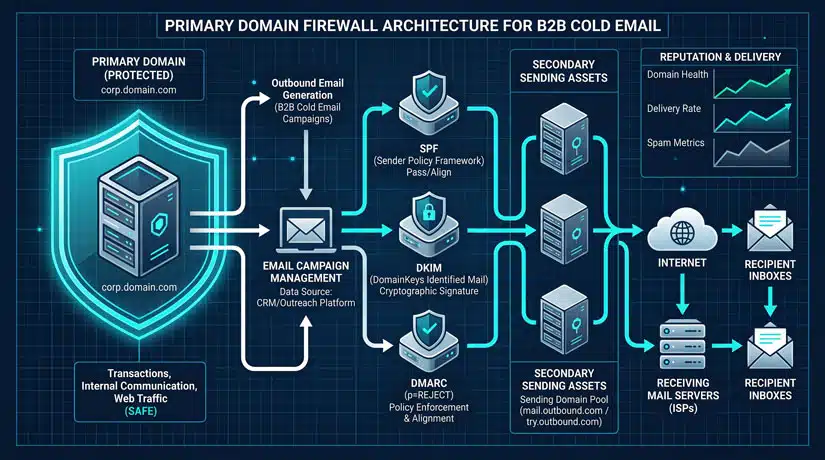
An enterprise outbound email infrastructure is only as strong as its technical isolation model. Routing high-volume B2B outreach through your primary corporate domain exposes your core business operations, transactional communications, and brand reputation to severe deliverability risks.
When an outbound campaign triggers spam complaints, high bounce rates, or spam trap hits, Internet Service Providers (ISPs) and Email Service Providers (ESPs)—including Google Workspace and Microsoft 365—apply domain-level throttling or IP blacklisting. If this occurs on your primary corporate domain (yourbrand.com), the consequences affect every corner of your business, from transactional invoices landing in customer spam folders to critical pitch decks being flagged by enterprise gateways.
By deploying secondary domain isolation as part of a dedicated Cold Email Infrastructure & Lead Reactivation strategy, you build a technical firewall between your core brand and cold outreach workflows. The secondary domains handle sending reputation shocks, while your primary domain remains isolated and protected.
1. Domain Asset Selection & Acquisition Strategy
The secondary domain portfolio must mimic your primary brand to maintain buyer trust while remaining completely distinct at the DNS and infrastructure level. Aligning your secondary assets with clean, established domains reinforces brand legitimacy while keeping your primary digital real estate untouched.
When selecting domains, use clear brand permutations such as adding prefix/suffix keywords (getsynctcollective.com, synctcollectiveapp.com) or action-oriented variants (usecompanyname.com). For guidance on how domain extensions impact buyer trust and machine retrieval, review our analysis on AEO domains and AI search engine trust.
Portfolio Sizing Rule: To maintain high inbox placement, limit individual inbox volume to 30–50 cold emails per day. Scale outreach horizontally by adding secondary domains and inboxes rather than increasing single-inbox volume. Assign a maximum of 2 to 3 active sending inboxes per secondary domain.
2. DNS Authentication & Protocol Architecture

Configuring DNS authentication records eliminates spoofing vulnerabilities and proves domain alignment to receiving mail servers.
SPF (Sender Policy Framework): Define strictly authorized IP addresses and servers allowed to send mail on behalf of the secondary domain.
- TXT Name:
@ - TXT Value (Google Workspace):
v=spf1 include:_spf.google.com ~all - TXT Value (Microsoft 365):
v=spf1 include:spf.protection.outlook.com ~all - Requirement: Never use
+all. Use~all(SoftFail) during warm-up, transitioning to-all(Fail) once infrastructure is validated.
DKIM (DomainKeys Identified Mail): Generate 2048-bit RSA cryptographic keys within your ESP admin console to sign outgoing message headers.
- TXT Selector:
google._domainkey - TXT Value:
v=DKIM1; k=rsa; p=MIIBIjANBgkqhkiG9w0BAQEFAAOCAQ8...
DMARC Policy Progression: Implement DMARC to enforce alignment between SPF and DKIM signatures. Enforce a progressive policy model over a 30-day deployment timeline:
- Days 1–14 (Monitoring):
v=DMARC1; p=none; rua=mailto:dmarc-reports@secondarydomain.com; - Days 15–30 (Quarantine):
v=DMARC1; p=quarantine; pct=100; - Days 31+ (Enforced Protection):
v=DMARC1; p=reject; pct=100;
Custom Tracking Domain Alignment: Disable generic third-party tracking links (which trigger security filters) and create an aligned CNAME record (link.secondarydomain.com) pointing to your sending platform to match the host header.
| Infrastructure Metric | Single Primary Domain | Isolated Secondary Architecture |
|---|---|---|
| Domain Reputation Risk | High (Entire business affected) | Zero (Isolated to secondary sending assets) |
| Transactional Email Safety | Vulnerable to campaign spam traps | 100% Protected on primary domain |
| DNS Protocol Strategy | Shared corporate SPF/DKIM | Strict custom SPF, DKIM & DMARC (p=reject) |
| Max Daily Capacity | Capped low to protect domain | Scales horizontally across inboxes |
| Web Traffic Handling | Direct rendering | 301 Redirect preserving UTM attribution |
3. Web Redirect Architecture & HTTP Response Headers
Every secondary domain will receive direct web traffic from prospective leads checking the domain’s credibility in their browser’s address bar.
Configure a server-level 301 permanent redirect mapping all web traffic from the secondary domain directly to your primary website:
http://getsynctcollective.com —> 301 Redirect —> https://synctcollective.com/
As detailed in our breakdown of why your domain name choice defines brand authority, establishing transparent 301 redirects ensures prospective leads land on your primary brand identity seamlessly without losing UTM attribution parameters.
High-Frequency Writing: E-commerce transactions, user activity logs, or real-time analytics tracking.
4. Automated Warm-Up Protocols & Sending Schedules
New secondary domains carry zero historical reputation. Launching cold campaigns immediately will trigger IP and domain flagging. Follow a strict daily ramp schedule per secondary inbox:
- Days 1–7 (Warm-up Only): 0 Cold Emails / Day | 5–15 Warm-Up Interactions
- Days 8–14 (Initial Ramping): 5 Cold Emails / Day | 20 Warm-Up Interactions
- Days 15–21 (Controlled Outreach): 15 Cold Emails / Day | 15 Warm-Up Interactions
- Days 22–28 (Scaling): 25 Cold Emails / Day | 15 Warm-Up Interactions
- Day 29+ (Production Cap): 35 Cold Emails / Day | 15 Warm-Up Interactions (Cap at 50 total operations)
Frequently Asked Questions (FAQs)
Q: Why should I use secondary domains for cold B2B email outreach?
A: Using secondary domains creates a technical firewall that shields your primary corporate domain from spam complaints, IP blacklisting, and ISP deliverability penalties. If a secondary domain’s reputation is damaged, your primary domain, internal business emails, and transactional messages remain completely unaffected.
Q: How many emails can I safely send per day per secondary inbox?
A: To maintain high inbox placement and avoid triggering ISP spam filters, cold email sending volume should be capped at 30 to 40 messages per inbox per day. Scale higher sending volumes horizontally across multiple secondary domains and inboxes rather than increasing single-inbox load.
Q: Should secondary domains redirect to my main website?
A: Yes. Every secondary domain should have a server-level 301 permanent redirect configured to forward web traffic to your primary website, ensuring prospective leads who type the domain into their browser land on your main brand site while preserving UTM tracking parameters.
Q: How long should I warm up a new secondary domain before sending cold emails?
A: A new secondary domain requires an automated warm-up period of 14 to 21 days using peer-to-peer engagement networks to establish SPF, DKIM, and DMARC trust with major ISPs before launching live outbound campaigns.
Ready to Protect Your Domain & Scale B2B Outreach?
Don’t risk your corporate domain’s delivery rates on cold outreach.
At Synct Collective, we design and deploy isolated outbound infrastructure, custom DNS authentication setups, and automated warm-up protocols engineered to safeguard your primary brand identity while keeping your campaigns out of spam folders.
Whether you need a deliverability audit, dedicated outbound setup, or high-speed WordPress architecture, our engineering team is here to help.

Dave Macdonald
Prior to founding Synct Collective, Dave was the founder of WP Tech Support, a global 24/7 maintenance and support agency that managed and secured over 600 WordPress sites worldwide. Having architected and maintained digital infrastructure at scale for hundreds of international site owners, his technical focus now centers on eliminating page-builder bloat, executing zero-downtime migrations, and optimizing server-level execution to deliver sub-second Core Web Vitals performance.
As an advocate for modern, future-proof web standards, Dave regularly writes on the intersection of native Gutenberg engineering, custom database architecture, structured JSON-LD schema design, and Answer Engine Optimization (AEO).

